Zeiss Ikon SW
Many are familiar with the term ‘blind Leica’, referring to the series of Leica M cameras produced without viewfinders. These cameras were intended industrial and medical use where the viewfinder was not required. Over the years Leica made a few different variations but never really went too far with the concept. These cameras can often be found at a fraction of the price and for people looking to use super wide-angle lenses or the Visoflex system they’re great value. But why are we talking about Leica when this is a review of a Zeiss camera? Well back in 2004 Zeiss announced the ZM, this would be a new 35mm Leica M mount rangefinder manufactured by Cosina. The camera shared many similarities to the most recent Leica, the M7 as this was the camera it was intended to compete with. In many ways the Zeiss Ikon ZM went onto outperform the M7 on a spec sheet but as with Voigtlanders M mount series of cameras never really stook a chance against the cult following that Leica already had. At the same time Zeiss also announced the Zeiss Ikon SW. The SW was essentially a ZM without the viewfinder/ rangefinder system. It still shared the same centre weighted meter, aperture priority modes and electronic shutter, just no viewfinder.
I had never shot with the original Zeiss Ikon ZM so this was my first time using this type of camera. The camera is very light only weighing 404g and feels nice in the hands. On the top of the camera, you will notice two accessory shoes. The centre one is intended for an external viewfinder to aid with composition, and the other one is a hot shoe which can be used for mounting a flash or bubble level. Also found on the top is the shutter speed dial which goes from bulb all the way up to 1/2000th of a second and when in aperture priority has exposure compensation with two stops +/-. This is thanks to the advanced electronic shutter. On the rear of the camera is one of my personal favourite features. 3 LED’s which indicate exposure settings. Below is a graph explaining what these LED’s mean in the different modes.
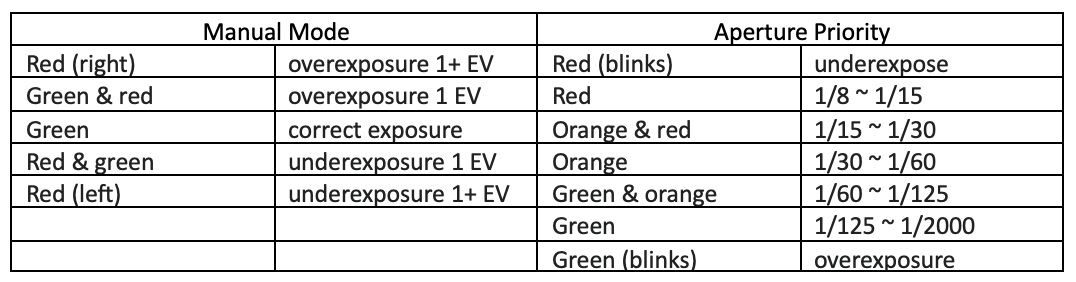
In practice I found this a fun camera to use. I initially wanted to pair the Leica 21mm Super Angulon lens with this camera for some fun ultra-wide work. But I forgot about the protruding rear element so settled for the Leica 28mm f2.8 Elmarit instead. I found it to be a very relaxed shooting experience especially when shooting wide and in aperture priority it kind of felt like using a point and shoot…. but in a good way. The first roll of film I shot was some Delta 3200 in London where I kept the camera in aperture priority and mainly shot around f/8 or f/11. Having the exposure indicator on the back of the camera really helped as it gave me an indication on what the shutter speed would be and allowed me to adjust if needed. It’s a very simple feature but one which works really well. I did find that the camera had a tendency to underexposure but I was shooting in often challenging conditions which would throw most meters. I didn’t get many keepers from this roll but that was mainly due to Delta 3200 being much grainier than I remembered and overall I am not a fan of this film stock.
The second two rolls of film were some Kodak Double X rated at 400 which I shot at Cwmorthin quarry in Wales. This time I wanted to shoot something with a little less grain. I knew most of my subject matter would be 10m + away so zone focusing wouldn’t be an issue. I feel landscapes is where this camera belongs, or work where you have time to more carefully compose frames.
Zeiss Ikon SW + Leica 28mm Elmarit V2 + Kodak XX
Zeiss Ikon SW + Leica 28mm Elmarit V2 + Kodak XX
Zeiss Ikon SW + Leica 28mm Elmarit V2 + Kodak XX
Zeiss Ikon SW + Leica 28mm Elmarit V2 + Kodak XX
Zeiss Ikon SW + Leica 28mm Elmarit V2 + Kodak XX
Zeiss Ikon SW + Leica 28mm Elmarit V2 + Kodak XX
After a short test run with this camera, I actually quite like it. I think if you are mainly a landscape photographer or shoot with lenses wider than 28mm then it’s a fun camera to use. I think it would be a great second or third camera but might be a little limiting as a main camera due to the lack of rangefinder.